
Step 1: Initial Consultation
How Engagement is Structured
A structured, consultative approach that aligns support with your research stage and academic needs
Step 2: Assessment
Step 3: Pathway Selection
Step 4: Guided Engagement
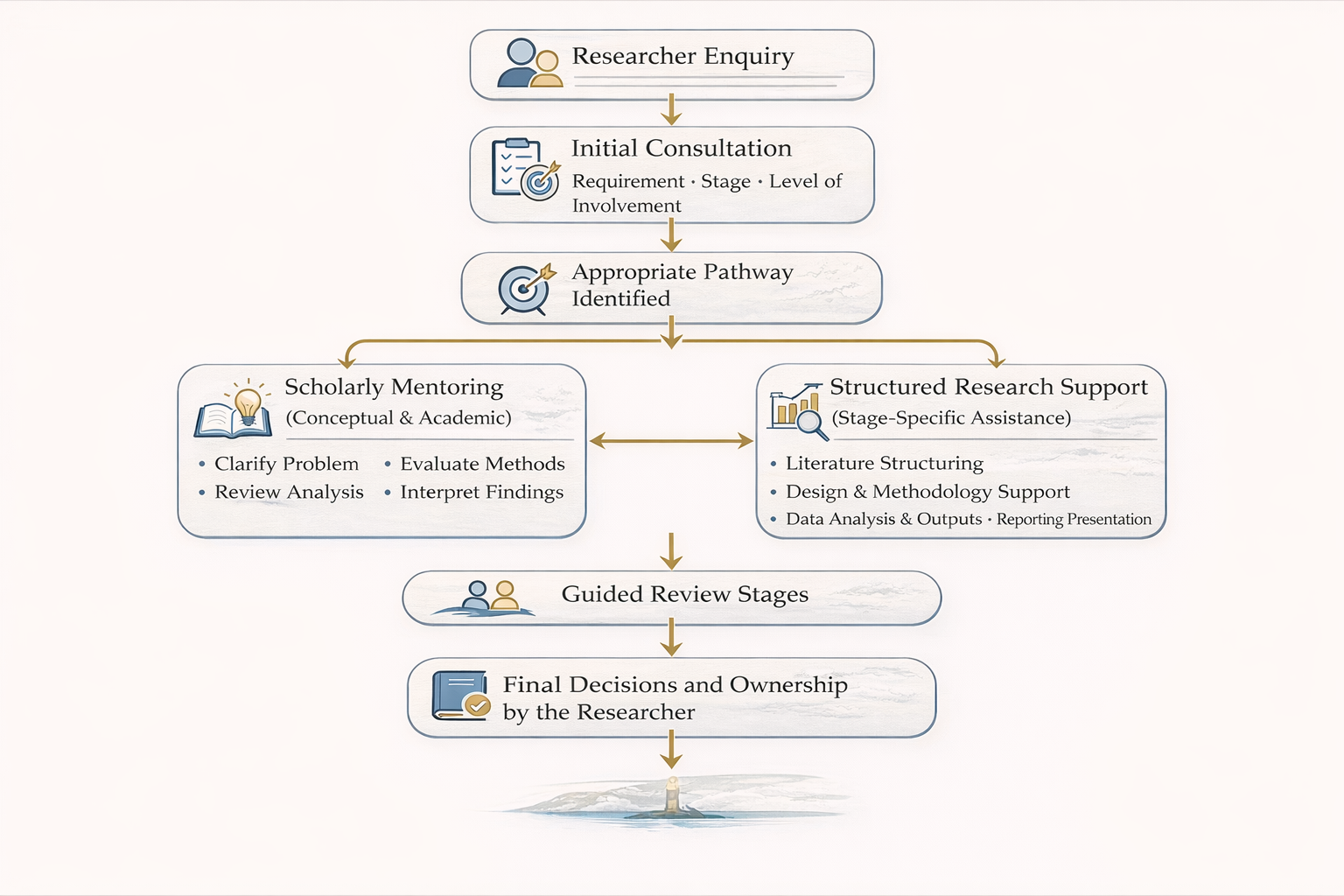
All engagements begin with an initial consultation, where the researcher’s requirement, stage of work, and level of academic involvement are carefully understood. This ensures that the form of support is appropriately aligned from the outset, with due consideration to the research context and academic expectations.
Based on this, researchers are guided into one of the following pathways:
- Scholarly Mentoring – for deeper academic engagement and strengthening research thinking
- Structured Research Support – for focused, stage-specific assistance
This approach ensures that support remains purposeful and clearly bounded, while maintaining academic rigor and preserving the researcher’s intellectual ownership and responsibility for the work. Each engagement is designed to strengthen the research process without compromising its integrity or authenticity.
Pathways of Engagement
Based on the structured assessment, researchers engage through one of two pathways, depending on the nature and depth of support required.
Scholarly Mentoring
(For conceptual clarity and academic decision-making)
Scholarly Mentoring focuses on strengthening the researcher’s ability to make sound academic decisions. Engagement is centred on working through critical aspects of the study, including:
- Refining the research problem and its theoretical grounding
- Examining methodological choices and their implications
- Reviewing analytical strategies and statistical reasoning
- Interpreting findings within the context of existing literature
The engagement is discussion-driven and iterative, enabling the researcher to develop clarity, confidence, and independent academic judgment.
👉 Explore Scholarly MentoringStructured Research Support
(For focused, stage-based assistance)
Structured Research Support supports specific components of the research process where technical or methodological input is required. Support is clearly defined, modular, and aligned to the researcher’s objectives, including:
- Organising and structuring literature reviews
- Supporting research design and methodological alignment
- Developing and validating research instruments
- Preparing data, conducting statistical analysis, and presenting outputs
- Structuring thesis or research papers for academic reporting
All support is delivered with guided review stages, ensuring that analytical and interpretive decisions remain aligned with the researcher’s understanding and academic responsibility.
👉 Explore Research Support Services